

Why Can't Everyone Find a Job? Understanding Unemployment in India
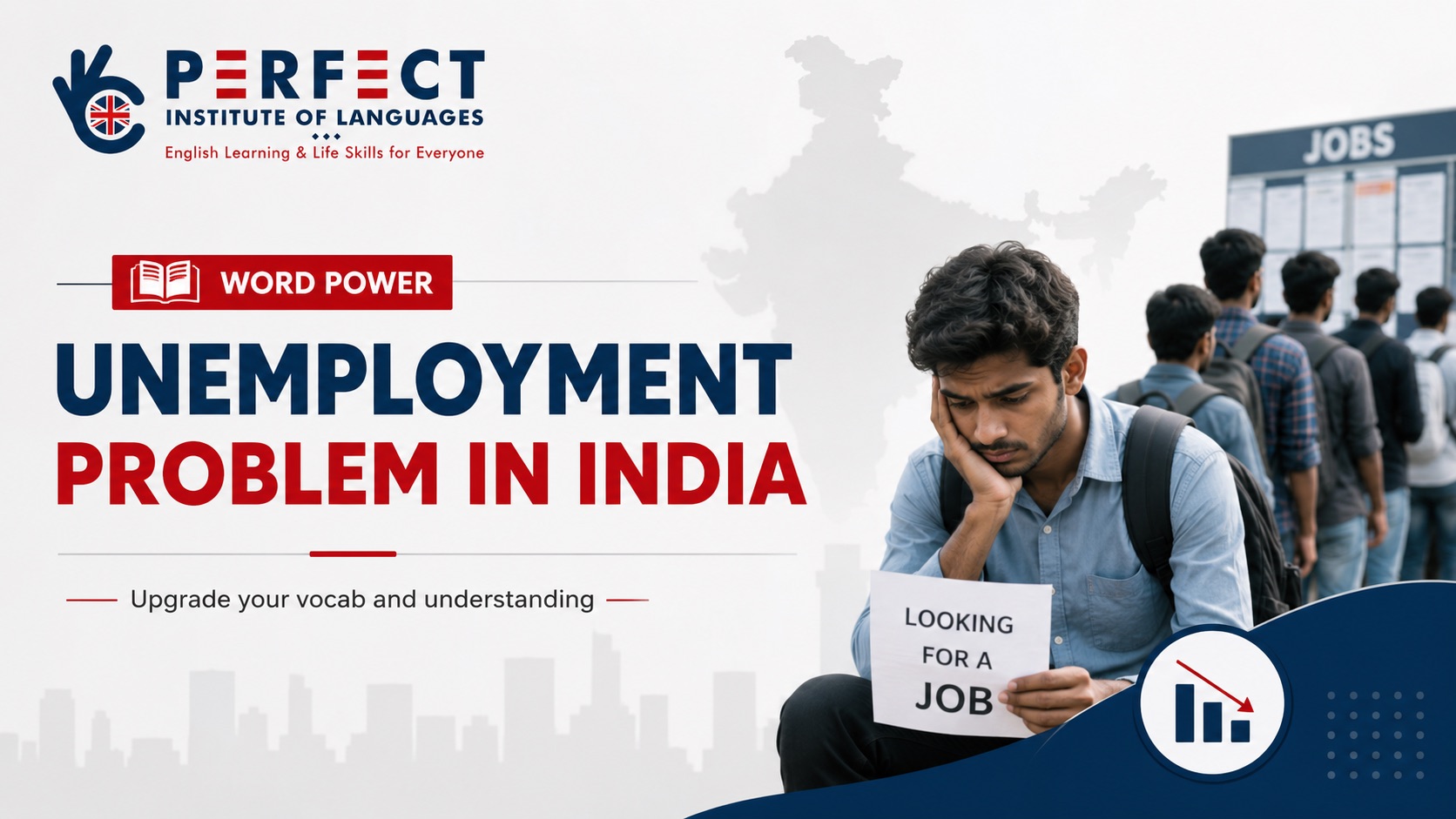
This blog is written for B1 English learners — clear language, real facts, and words that will make you sound confident.
By Keshav Verma | Perfect Institute of Languages | Language Level: B1
India is a country of dreams. Every year, millions of young people finish school and college, full of hope and ambition. They want a good job, a stable income, and a better life. But for many of them, finding work is not easy. This is the problem of unemployment — and it is one of the biggest challenges that India faces today.
In this blog, we will talk about what unemployment means, why it happens, what effects it has on people and the country, and what can be done about it. As you read, pay attention to the bold words — they are important vocabulary that will help you speak and write more confidently about social and economic topics.
What Is Unemployment?
Simply put, unemployment means the condition of not having a job, even though a person is able to work and is actively looking for one. It is important to understand that unemployed people are not lazy. They want to work — they just cannot find a suitable job.
Economists and governments measure unemployment using something called the unemployment rate — the percentage of people in the workforce who do not have a job. The workforce means all the people in a country who are old enough and able to work.
According to the Centre for Monitoring Indian Economy (CMIE), India's unemployment rate rose to 9.2% in June 2024, up from 7% in May 2024. Even in relatively better months, the rate stayed between 7.6% and 8.7% through 2024 — which means millions of people in India are without work at any given time.
"India adds over a crore young people to its workforce every year — but the economy is not creating enough jobs to absorb all of them."
Why Does Unemployment Happen? The Root Causes
There is no single reason for unemployment. It is a problem caused by many factors working together. Let us look at the most important ones.
1. Too Many People, Too Few Jobs
India's population is enormous. With over 1.4 billion people, there are far more job seekers than available jobs. The supply of workers is much greater than the demand for workers — this basic imbalance is at the heart of the problem.
According to India's Economic Survey 2023-24, the country needs to create 78.5 lakh (7.85 million) new non-agricultural jobs every year until 2030 just to keep up with the growing workforce. That is an enormous number of jobs to create every single year.
2. The Skill Gap — The Most Surprising Cause
Here is a fact that surprises many people: in India, the more educated you are, the harder it can be to find a job.
The International Labour Organisation (ILO), in its India Employment Report 2024, found that the unemployment rate among graduates was 29.1% — almost nine times higher than the 3.4% rate for those who cannot read or write. The unemployment rate for young people with secondary education or higher was 18.4%.
Why? Because there is a deep mismatch between what Indian colleges teach and what employers actually need. The India Skills Report 2025 found that only 54.81% of Indian graduates are considered employable by industry standards. The Graduate Skill Index even reported a decline to 42.6% employability in 2024, meaning more than half of graduates are not ready for the job market.
Furthermore, according to the Periodic Labour Force Survey (PLFS) 2022-23, only 4.4% of Indian youth aged 15–29 have ever received formal vocational training. About 65% have received no vocational or technical training at all.
3. Seasonal Unemployment in Farming
India's agricultural sector employs nearly 45% of the total workforce, according to the Economic Survey. But farming is seasonal — work is only available during planting and harvest time. For the rest of the year, crores of farmers and farm workers have no income. This is called seasonal unemployment.
4. The Rise of Automation
The growth of automation — using machines and computers to replace human workers — is changing the job market rapidly. While technology creates new opportunities, it also destroys old ones. The Economic Survey 2024-25 noted that 88.2% of India's workforce is currently employed in low-skill, low-competency jobs — exactly the kind of work most at risk from automation.
5. Weak Infrastructure in Rural Areas
The lack of infrastructure in villages — roads, electricity, internet — means new businesses don't open in rural areas. So people migrate to cities looking for work, and cities become overcrowded with job seekers competing for the same positions.
The Effects: What Unemployment Does to People and Society
Unemployment is not just a number on a chart. It has real, painful effects on real people.
83% of India's unemployed are young people. According to the ILO India Employment Report 2024, youth — those under 34 years of age — make up 83% of India's jobless population. Even more worrying, the share of educated youth among the unemployed has risen from 54% in 2000 to 66% in 2022.
When a person cannot find work, their financial stability disappears. They cannot pay rent, buy food, or support their family. This leads to poverty — a condition where people do not have enough money for basic needs. Poverty and unemployment are deeply connected.
Unemployment also affects mental health. People who are unemployed for a long time often feel anxiety, hopelessness, and low self-confidence. In India, where job status is closely tied to social identity, being unemployed can carry a deep sense of shame — even when it is not the person's fault.
At the national level, high unemployment slows economic growth. When people don't earn, they don't spend. When they don't spend, businesses don't grow. It is a cycle that can drag down the entire economy.
Women are especially affected. According to the ILO, women accounted for 76.7% of educated unemployed youth in India. India also has one of the lowest female labour force participation rates in the world, at around 25%. And according to Pearson's 2024 research, about 23% of India's 15-24 year-olds are NEET — Not in Education, Employment, or Training.
"Unemployment is not just an economic problem — it is a human problem. It takes away a person's dignity, purpose, and hope."
What Can Be Done? Possible Solutions
The good news is that unemployment is not an unsolvable problem. Governments, businesses, and individuals can all take action.
1. Fix Vocational Training
The most important step is improving vocational training. Right now, only 4.4% of Indian youth have received formal vocational training — compared to 68% in the United Kingdom. If India can close this gap, millions more young people will become employable. The government's Skill India Mission, launched in 2015, aims to do exactly this — training youth through ITIs, polytechnics, and vocational centres.
2. Build Infrastructure
The government must invest in roads, electricity, internet, and schools in rural areas. This creates jobs directly and encourages private businesses to open outside major cities. Notably, Tier 2 and Tier 3 cities showed a 21% year-on-year growth in hiring in 2025, showing that decentralisation of jobs is already working.
3. Encourage Entrepreneurship
When people start their own businesses, they create jobs for others too. Government schemes like Startup India, Mudra Loan Yojana, and the PM Internship Scheme — which targets 10 million youth over five years — are steps in the right direction. MSMEs (Micro, Small and Medium Enterprises) already contribute over 30% of India's GDP and are the second-largest employer after agriculture.
4. Align Education With Industry
Universities and colleges must update their courses to match what industries actually need. Management graduates have an employability rate of 78% and engineering graduates 71.5% — proof that when education matches industry needs, people find jobs. The same principle must be applied across all fields.
5. Take Personal Initiative
Finally, individuals must take initiative. The job market rewards those who are adaptable and proactive. Learning English, building digital skills, networking on platforms like LinkedIn, and being open to new kinds of work — including gig and freelance roles — can open many doors that a degree alone cannot.
Conclusion: Hope and Hard Work
Unemployment in India is a complex and serious problem — but it is not hopeless. India is a young country, and that is actually a great strength. Economists call this the "demographic dividend" — the economic benefit that comes from having a large, young, productive population.
According to the Ministry of Labour & Employment, total employment in India rose from 47.5 crore in 2017-18 to 64.33 crore in 2023-24 — an addition of over 16 crore jobs in six years. This shows real progress. But more must be done, faster.
If India can bridge the skill gap, create better infrastructure, support entrepreneurship, and reform education, there is every reason to be optimistic about the future.
As a learner of English, understanding topics like this not only improves your vocabulary — it also makes you a more informed and thoughtful citizen. And that is always a good thing.
📖 Vocabulary Summary
Study these words carefully — they will help you speak and write confidently about jobs, economy, and society.
1. Unemployment (noun) /ˌʌn.ɪmˈplɔɪ.mənt/ The state of not having a job, even though you are able to work and are looking for one. "Unemployment is one of the biggest economic challenges in India."
2. Workforce (noun) /ˈwɜːk.fɔːs/ All the people in a country who are available and able to work. "India adds over a crore people to its workforce every year."
3. Skill Gap (noun phrase) The difference between the skills employers need and the skills workers actually have."The skill gap is a major reason why many graduates cannot find jobs."
4. Mismatch (noun) /ˈmɪs.mætʃ/ A situation where two things do not go together well or do not match each other."There is a mismatch between what colleges teach and what companies require."
5. Automation (noun) /ˌɔː.təˈmeɪ.ʃən/ The use of machines or computers to do work that was previously done by people. "Automation in factories is reducing the number of manual jobs available."
6. Seasonal Unemployment (noun phrase) Unemployment that happens only at certain times of the year, especially in farming. "Farmers face seasonal unemployment during months when there is no crop to harvest."
7. Infrastructure (noun) /ˈɪn.frəˌstrʌk.tʃər/ The basic systems a country needs to function — roads, electricity, internet, and schools. "Poor infrastructure in villages makes it hard for businesses to grow there."
8. Financial Stability (noun phrase) The condition of having a steady and secure income so you can meet your basic needs. "Losing a job destroys a family's financial stability."
9. Poverty (noun) /ˈpɒv.ə.ti/ The condition of not having enough money to meet basic needs like food, housing, and clothing. "Unemployment and poverty are closely connected."
10. Economic Growth (noun phrase) An increase in the production of goods and services in a country, leading to more wealth. "High unemployment can slow down economic growth significantly."
11. Vocational Training (noun phrase) /vəˈkeɪ.ʃən.əl ˈtreɪ.nɪŋ/ Education that teaches practical, hands-on skills for a specific job or trade. "Vocational training in coding or plumbing can help many young people find work."
12. Employable (adjective) /ɪmˈplɔɪ.ə.bəl/ Having the skills and qualities that make it easy to find and keep a job."Good English communication skills make a person more employable."
13. Entrepreneurship (noun) /ˌɒn.trə.prəˈnɜː.ʃɪp/ The activity of starting and running your own business, taking financial risks to do so. "Encouraging entrepreneurship is one of the best ways to create more jobs."
14. Demographic Dividend (noun phrase) The economic benefit a country gets when it has a large, young, and productive population. "India can benefit from its demographic dividend if young people are educated and employed."
15. Job Market (noun phrase) The total number of jobs available in an economy and the competition among job seekers. "The job market is very competitive in India today."
16. Initiative (noun) /ɪˈnɪʃ.ə.tɪv/ The ability and willingness to start doing something without being told to. "Young people must take initiative and keep learning new skills."
17. Optimistic (adjective) /ˌɒp.tɪˈmɪs.tɪk/ Feeling hopeful and positive about the future, believing that good things will happen. "Despite the challenges, there are reasons to be optimistic about India's future."
18. Imbalance (noun) /ɪmˈbæl.əns/ A situation where two things are not equal or not in the correct proportions. "The imbalance between job seekers and available jobs is the root of unemployment."
Data points added from trusted sources:
- CMIE — 9.2% unemployment rate (June 2024), monthly fluctuations through 2024
- ILO India Employment Report 2024 — 29.1% graduate unemployment, 83% of jobless are youth, women's share in educated unemployed
- India Economic Survey 2023-24 — 78.5 lakh jobs needed per year until 2030
- India Skills Report 2025 (Wheebox & CII) — 54.81% graduate employability rate
- PLFS 2022-23 — only 4.4% of youth have formal vocational training
- Ministry of Labour & Employment — 16+ crore jobs added between 2017-18 and 2023-24
- Pearson 2024 — 23% of India's youth are NEET
- Economic Survey 2024-25 — 88.2% of workforce in low-competency jobs
By Keshav Verma | Perfect Institute | Helping you learn English — one real topic at a time