
Drug Addiction: A Silent Epidemic Among Youth
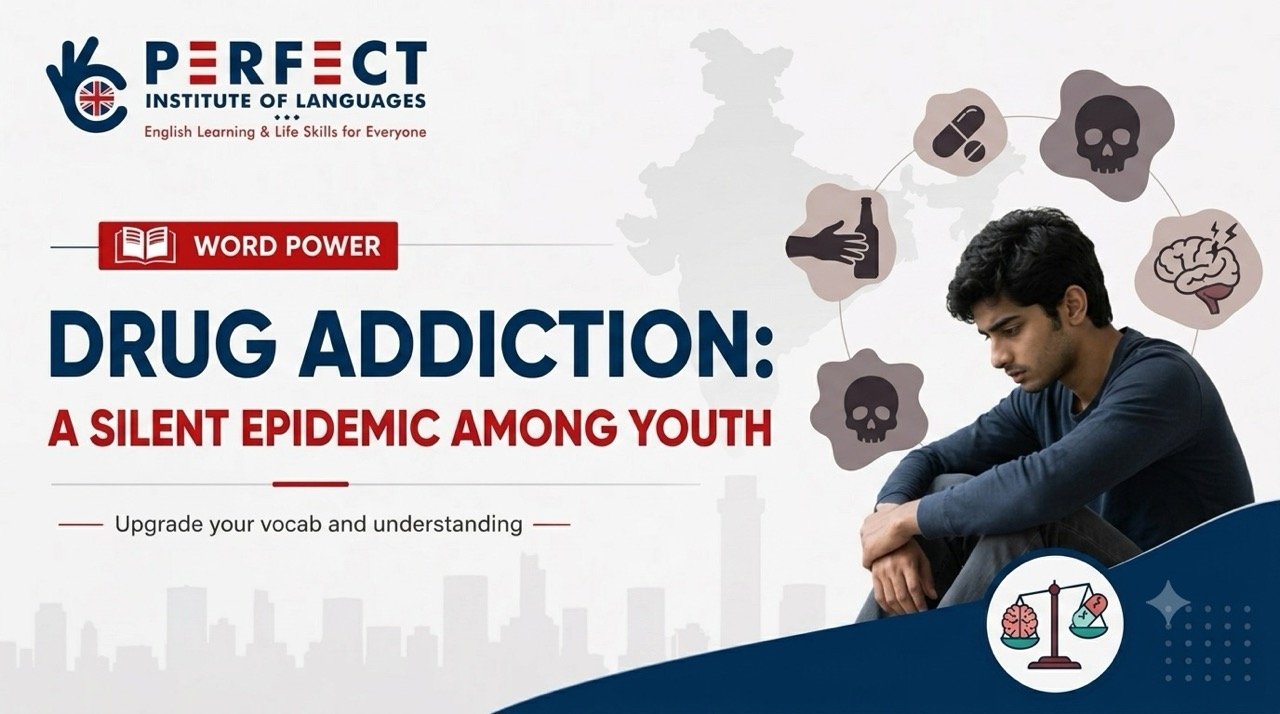
Drug Addiction: The Silent Epidemic Among India's Youth
A blog written for B1 English learners — clear language, real data, and words that will build your confidence.
By Keshav Verma | Perfect Institute of Languages, Shimla | Level: B1
Imagine a classroom of thirty students. Now imagine that, statistically, four or five of them have already tried a harmful substance — not as adults, but as children barely into their teenage years. This is not a hypothetical scenario. It is the reality that a growing body of Indian research is now revealing.
We call it a "silent epidemic" because, unlike a health crisis that makes headlines every day, drug addiction among young people spreads quietly — inside homes, schools, and friend groups — hidden by shame, fear, and silence. Families often do not talk about it. Schools often do not address it. And by the time it becomes visible, the damage is already deep.
In this blog, we will look honestly at what the data tells us, why this crisis is growing, what it costs individuals and society, and what is being done — and what more needs to be done — to address it. As you read, pay attention to the bold words — they are important vocabulary for discussing public health and social issues in English.
A note before we begin: this blog discusses addiction at a general, informational level — its causes, effects, and support systems — and does not describe how substances are used or obtained. If you or someone you know needs help, India's toll-free de-addiction helpline, 1-800-11-0031 / 14446, is available for confidential support.
Understanding the Scale of the Problem
Addiction is a condition in which a person becomes unable to control their use of a substance, even when it is clearly causing harm to their health, relationships, or future. It is recognised by doctors worldwide as a medical condition — not a matter of "weak character" or poor choices, though that is sadly how it is often judged in Indian society.
The most comprehensive data on this subject comes from the National Survey on Extent and Pattern of Substance Use in India (2019), conducted by the National Drug Dependence Treatment Centre (NDDTC), AIIMS Delhi, on behalf of the Ministry of Social Justice and Empowerment. This survey — the largest of its kind, covering over 5 lakh individuals across all states and union territories — found that roughly 16 crore (160 million) Indians were current users of alcohol, and that crores more used other substances.
What is most alarming is when this journey begins. A newer, December 2025 multi-city survey by AIIMS Delhi's NDDTC, published in the National Medical Journal of India, studied nearly 6,000 school students across ten Indian cities — including Delhi, Mumbai, Bengaluru, Chandigarh, and Lucknow. It found that the average age of first exposure to any harmful substance was just 12.9 years — meaning children are encountering these substances while still in middle school. The study also found that students in Classes 11 and 12 were twice as likely to report substance use compared to those in Class 8, showing how the problem escalates rapidly through the teenage years.
"A child's first exposure to addiction often happens not in secrecy on the streets, but quietly, at home or among friends, before the age of thirteen."
Why Does This Happen? Understanding the Root Causes
Addiction among young people is rarely caused by one single factor. It usually results from a combination of psychological, social, and environmental pressures.
1. Peer Pressure and the Need to Belong
Adolescence is a time when young people desperately want to fit in with their friend group. Peer pressure — the influence of friends to behave in a certain way — is one of the strongest drivers of early substance use. A teenager may try something harmful simply because "everyone else is doing it," fearing exclusion or mockery if they refuse.
2. Academic Pressure and Emotional Distress
India's education system, as we discussed in an earlier blog, places enormous pressure on students to perform well in exams. This intense academic pressure, combined with fear of failure and family expectations, pushes some students toward substances as a form of escape or a harmful coping mechanism — a way of dealing with stress or difficult emotions.
The AIIMS 2025 survey found something particularly striking: while 95% of surveyed students believed drugs were harmful, many still experimented — showing that knowledge alone does not prevent use when emotional distress is the underlying driver. The survey also found rising substance use among girls, often linked to self-medication for anxiety and emotional pain.
3. Family Environment
A child's home environment plays a critical role. Research consistently shows that family conflict, lack of emotional support, and exposure to substance use within the household increase a young person's vulnerability. Strikingly, the AIIMS survey found that 40% of surveyed students reported the presence of substances within their own homes— meaning exposure often begins closer to home than many parents realise.
4. Media Glamorisation
Films, music, and social media often glamorise substance use — presenting it as fashionable, rebellious, or a symbol of success and modernity. When young, impressionable minds repeatedly see substances portrayed this way, it gradually normalises behaviour that is, in reality, deeply harmful.
5. Socio-Economic Factors
Poverty, unemployment, and lack of access to education, sports, or recreational activities can also push young people — especially in vulnerable communities — toward substance use as an escape from difficult life circumstances. Where opportunity is scarce, despair can become fertile ground for addiction.
The Real Cost: Effects on Individuals and Society
Drug addiction is not a private problem contained within one person's life. Its effects ripple outward, touching families, schools, workplaces, and entire communities.
On the Individual: Addiction damages physical health, disrupts brain development (which continues until the mid-twenties), and is closely linked to anxiety, depression, and other mental health disorders. Academically, it leads to declining grades, absenteeism, and — in serious cases — dropping out of school entirely, connecting back to the education crisis we explored earlier.
On the Family: Families of individuals struggling with addiction often experience significant emotional and financial strain, along with the heavy weight of social stigma — the shame and judgment that Indian society often attaches to addiction, which prevents many families from seeking help.
On Society: According to the UNODC World Drug Report 2024, global drug use has reached 292 million people — a 20% increase over the past decade. Alarmingly, the report found that only 1 in 11 people with a diagnosed substance use disorder receive treatment — and for women, the gap is even worse, with only 1 in 18 receiving help, compared to 1 in 7 men. This is known as the treatment gap, and it exists strongly in India too.
Perhaps most troubling of all: in the AIIMS 2025 school survey, only 1% of students who reported substance use had ever sought professional help. This is the true meaning of a "silent" epidemic — a crisis affecting millions, discussed by almost no one.
Regional Patterns: A Nationwide Concern
Substance use patterns vary significantly across India, according to the 2019 NDDTC-AIIMS survey and Home Ministry data. States like Uttar Pradesh, Punjab, and Maharashtra report high overall case numbers, while Chhattisgarh, Tripura, and Punjab report high alcohol use. The northeastern states of Sikkim, Arunachal Pradesh, Nagaland, Manipur, and Mizoram — many bordering the international "Golden Triangle" drug-trafficking region — report the highest rates of opioid use. Punjab alone reported over 6.25 lakh minors using various substances, according to government data presented in the Rajya Sabha in 2024.
This tells us something important: this is not a problem limited to one city, one class, or one type of family. It is a genuinely nationwide public health concern, cutting across geography and social class.
What Is Being Done? Government and Community Response
The good news is that India has recognised this crisis and is responding — though experts agree far more needs to be done.
The Ministry of Social Justice and Empowerment runs the National Action Plan for Drug Demand Reduction (NAPDDR), a comprehensive scheme focused on prevention, treatment, and rehabilitation — the process of helping someone recover and reintegrate into normal life after addiction. Under this plan, the government supports 74 Outreach and Drop-In Centres (ODICs) that provide counselling and referral services, along with 66 Addiction Treatment Facilities in government hospitals across the country, implemented through AIIMS, New Delhi.
For anyone seeking confidential help, India runs a toll-free de-addiction helpline — 14446 — providing primary counselling and immediate referral to treatment services.
Perhaps most importantly, in July 2025, the government launched a new, updated National Survey on Extent and Pattern of Substance Use, in collaboration with NDDTC-AIIMS — the first major update since 2019 — which will provide fresh state-level and district-level data to guide better policy.
Experts, including the researchers behind the 2025 AIIMS study, are calling urgently for school-based intervention programmes starting before middle school, trained school counsellors, family education initiatives, and — critically — a reduction in the stigma that currently stops young people and families from seeking help. As the researchers noted, delaying the age at which a young person first tries a harmful substance, even by a single year, meaningfully reduces their lifetime risk of developing a substance use disorder.
"The single most powerful intervention is not punishment — it is prevention, early conversation, and a society willing to talk about addiction without shame."
Conclusion: Breaking the Silence
Drug addiction among India's youth is a genuine public health crisis — but it is one that thrives specifically in silence. When families cannot discuss it, when schools do not address it, and when society treats addiction as a source of shame rather than a health condition needing care, the epidemic continues to spread quietly.
The path forward requires collective responsibility: parents who create safe, open channels of communication with their children; schools that build resilience and life skills, not just academic performance; a healthcare system that expands access to counselling and treatment; and a society that replaces judgment with support.
Every child deserves the chance to grow up without falling into this silent crisis. Breaking that silence — through honest conversation, awareness, and compassion — is the first and most powerful step.
📖 Vocabulary Summary
These words appeared in this blog. Learn them to discuss public health and social issues confidently in English.
1. Epidemic (noun) /ˌep.ɪˈdem.ɪk/ A widespread occurrence of a harmful condition affecting a large number of people at the same time. "Experts describe youth drug addiction in India as a silent epidemic."
2. Addiction (noun) /əˈdɪk.ʃən/ A medical condition in which a person cannot control their use of a substance despite clear harm. "Addiction is recognised by doctors as a medical condition, not a personal failure."
3. Prevalence (noun) /ˈprev.əl.əns/ How widespread or common something is within a particular population. "The survey measured the prevalence of substance use among Indian school students."
4. Peer Pressure (noun phrase) The influence that people of the same age exert on each other to behave in a certain way. "Peer pressure is one of the strongest reasons young people first try harmful substances."
5. Coping Mechanism (noun phrase) A strategy a person uses, consciously or unconsciously, to deal with stress or difficult emotions. "Some students turn to substances as an unhealthy coping mechanism for academic stress."
6. Vulnerability (noun) /ˌvʌl.nər.əˈbɪl.ɪ.ti/ The state of being easily harmed, influenced, or affected by negative circumstances. "A difficult family environment can increase a child's vulnerability to substance use."
7. Glamorise (verb) /ˈɡlæm.ər.aɪz/ To make something appear attractive, exciting, or desirable, often ignoring its real dangers. "Films and social media sometimes glamorise substance use, making it seem fashionable."
8. Normalise (verb) /ˈnɔː.məl.aɪz/ To make something seem normal, acceptable, or ordinary, even if it is actually harmful. "Repeated exposure in media can normalise behaviour that is genuinely dangerous."
9. Stigma (noun) /ˈstɪɡ.mə/ A feeling of shame or disapproval that society attaches to a particular condition or behaviour. "Social stigma prevents many Indian families from seeking help for addiction."
10. Escalate (verb) /ˈes.kə.leɪt/ To increase quickly in intensity, seriousness, or scale. "Substance use tends to escalate significantly between middle school and higher secondary school."
11. Mental Health Disorder (noun phrase) A condition that affects a person's emotional, psychological, or behavioural well-being. "Addiction is closely linked to mental health disorders like anxiety and depression."
12. Treatment Gap (noun phrase) The difference between the number of people who need medical treatment and those who actually receive it. "The global treatment gap means only 1 in 11 people with a substance use disorder get help."
13. Rehabilitation (noun) /ˌriː.hə.bɪl.ɪˈteɪ.ʃən/ The process of helping someone recover from addiction or illness and return to a healthy, normal life. "Rehabilitation centres provide counselling and support to help people recover from addiction."
14. Intervention (noun) /ˌɪn.təˈven.ʃən/ An action taken to improve or change a difficult or harmful situation, especially early on. "Experts recommend school-based intervention programmes starting before middle school."
15. Self-Medication (noun phrase) The practice of using a substance to try to relieve emotional pain or symptoms without professional guidance. "Some researchers link rising substance use among girls to self-medication for anxiety."
16. Resilience (noun) /rɪˈzɪl.i.əns/ The capacity to recover from difficulties and cope well with stress or hardship."Schools should focus on building resilience and life skills, not just academic results."
17. Collective Responsibility (noun phrase) A shared duty among a group of people — such as families, schools, and society — to address a problem together. "Solving the addiction crisis requires collective responsibility, not blame placed on one person."
18. Despair (noun) /dɪˈspeər/ A complete loss of hope, often caused by very difficult circumstances. "In communities with limited opportunity, despair can make young people more vulnerable to addiction."
📚 Data Sources Used in This Blog: National Survey on Extent and Pattern of Substance Use in India (2019), NDDTC-AIIMS Delhi & Ministry of Social Justice and Empowerment · AIIMS Delhi 10-City School Survey, published in the National Medical Journal of India (December 2025) · UNODC World Drug Report 2024 · Ministry of Home Affairs data via Rajya Sabha reply (2024) · National Action Plan for Drug Demand Reduction (NAPDDR), Government of India · National Institute of Social Defence (NISD)
If this topic affects you or someone you know: India's national de-addiction helpline — 14446 (or 1-800-11-0031) — offers free, confidential counselling and can guide you to nearby treatment centres.
By Keshav Verma | Perfect Institute | Helping you learn English — one real topic at a time